welcome!
Laboratory of Interfacial & Small Scale Transport
{LIS2T}
About Us
For up-to-date research projects, please
refer to listings at Job Openings.
Research Topics of Interest
The {LIS2T} research group specializes in the science and design of micro- and nanoscale systems and devices involving nonlinear wave phenomena in ultrathin films. Of particular interest are phenomena based on the transfer of mass, momentum, heat and light along moving interfaces. Selected ares of current experimental interest include non-contact fabrication of 3D micro-optical components by surface force modulation; micro-propulsion and microfluidic technologies for future surveillance and planetary missions; Marangoni driven spreading in oil sheen phenomena; boundary slip in nanofilms; and Marangoni or thermocapillary waves at air/liquid interfaces. Selected ares of current theoretical interest include slip phenomena due to momentum or thermal exchange at liquid/solid interfaces; resonance phenomena in ultrathin films driven by surface forces; Lie algebraic approaches to symmetry classes governing moving boundary problems; nonlinear dynamics of thermally driven systems; and generalized stability analysis of Stokes flows.
Systems confined to very small dimensions manifest exceedingly large surface to volume ratios and are therefore highly responsive to spatiotemporal control of surface forces and structure formation. We mostly focus on phenomena involving surface forces which derive from spatial gradients in electrical, thermal, magnetic, or concentration fields. These gradient forces, which act in the direction both parallel and perpendicular to an interface, can be manipulated to direct the flow of momentum, heat, light and mass. In molten systems, these forces can effect desired shape changes on demand since inertial effects and phase lag at these length scales are typically negligible. We use this capability of directed transport either to probe fundamental physical behavior of micro/nanosystems or to fabricate arbitrarily complex 3D structures for optical or photonic applications. During the past decade, we have investigated the nonlinear coupling of surface forces, confinement effects and system geometry to elicit both fundamental understanding of transport phenomena at small scales and to harness patterning forming instabilities for lithographic applications. These studies have revealed a number of ways in which spatiotemporal control of gradient fields can be used to modulate the transport of mass, momentum or energy in small liquidic structures.
On the theoretical side, our studies have uncovered interesting correlations and scaling laws which arise as a consequence of self-similarity, confinement effects, non-normality or linear and nonlinear instabilities. Examples include the influence of non-modal perturbations on instability and patterned growth in free surface films, layering phenomena in nanofilms, phase transitions and slip in nanoscale liquid layers confined by "soft walls", and substrate induced ordering and dissipation reduction at liquid/solid interfaces. We are also investigating phonon behavior and Kaptiza effects in polymeric nanofilms so as to design interfaces with good overlap in phonon transmission spectra. Our group also has a long standing interest in pattern forming microscale flows whose base states are spatially inhomogeneous due to surface forces triggered by gradients in lipid concentration. These systems provide interesting analogs for studies of interfacial phenomena in small scale flows driven far from equilibrium. On the applications side, we are exploiting directed motion by remote thermocapillary actuation to build miniature "hot and cold chips" with integrated evanescent sensing for micro- and optofluidic applications. Currently, we are developing a novel lithographic technique called Interface Modulation Lithography {IML} for fabricating optical and photonic microarrays in which the growth of nanostructures is controlled by patterned gradient force fields. For space applications and in conjunction with ongoing experiments at the Jet Propulsion Laboratory, we are also conducting modeling work for future precision orbit devices.
To explore these phenomena spanning multiple length scales, we typically complement our laboratory experiments with analytic work and numerical computations including finite element and non-equilibrium molecular dynamics simulations. This combined approach has proven extremely useful in developing physical insight for theoretical advances as well as design principles for application driven work.
{LIS2T} is currently recruiting Postdoctoral Research Associates, Graduate Students and Undergraduate Research Assistants for projects ranging from theoretical analysis to numerical simulations to laboratory experiments and image processing. Please find below a listing of current research projects. Additional descriptions can be found under the tab "Job Openings" at the top of this page. Consider joining our eclectic group for some serious fun!
Current projects: Fundamental studies
Current projects: Application driven studies
Principal Investigator: Biography and Lifelong Research Interests
Prof. Troian directs the Applied Physics Laboratory of Interfacial and Small Scale Transport {LIS2T} at the California Institute of Technology. Her research group specializes in the fundamental science and design of micro- and nanoscale systems involving nonlinear wave phenomena in ultrathin films. Of particular interest are natural or designed phenomena caused by the transport of mass, momentum, heat and light along moving interfaces. Her group relies on theoretical analysis, numerical modeling, experimental work and molecular scale simulations to elucidate system behavior spanning many length scales.
Troian received her B.A. in Physics from Harvard University (1980) and her M.S. (1984) and Ph.D (1987) in Physics from Cornell University. With N. D. Mermin, she developed the first mean field model based on Landau theory for first order phase transitions in quasicrystals. This model revealed how classes of aperiodic structures with icosahedral symmetry can be more energetically favorable than conventional crystalline ordering like BCC or FCC. From 1987-89, Troian was a Postdoctoral Research Associate with the Condensed Matter Physics Group of the Corporate Research Labs at Exxon Research & Engineering Co. There, she used a combination of analytic and experimental work to unveil the source of instability in two classes of thin film flows. The first class exhibits parallel elongations which emanate from the advancing front of many thin film problems driven either by body forces(e.g. gravity or centrifugation) or surface forces (e.g. thermocapillarity). The second class exhibits dendritic patterns which emanate behind the advancing front in thin film problems driven by surface forces (e.g. Marangoni). In 1989, she was awarded a Chateaubriand Research Fellowship to continue this work at the Laboratoire de Physique de la Matière Condensée at the Collège de France in Paris. There she explored how thermocapillary forces can be used to trigger or stabilize leading edge instabilities in microfilms subject to a constant thermal gradient. In a separate study, she examined which energy release mechanisms are dominant during fracture of entangled bulk polymer systems. She returned to the US in 1990 to join the Exxon Research Corporate Research Center in Annandale, NJ as a Staff Physicist. Her interest there in spinodal decomposition phenomena led her to identify how the coupling of Lifshitz-Slyozov dynamics with domain coalescence near a solid boundary can lead to "super-diffusive" growth in binary mixtures. At Exxon, she also investigated hydrodynamic models for oil spill tracking algorithms with emphasis on Marangoni driven coverage during the late stages of an ocean spill.
In 1993, Dr. Troian joined the faculty in the School of Engineering & Applied Science at Princeton University as an Assistant Professor. She was promoted to Associate Professor with tenure in 1999 with affiliation to the Dept. of Physics, Program in Applied and Computational Mathematics, and Dept. of Chemical Eng. She received promotion to Full Professorship in 2002 with additional affiliation to the Dept. of Mechanical and Aerospace Eng. During this period, she established an extensive theoretical and experimental program focused on the physics of surface forces and the modulation of momentum transfer in ultrathin films. At Princeton, she expanded her work beyond continuum-based hydrodynamics and began investigating slip phenomena in confined nanoscale films using non-equilibrium molecular dynamics simulations. These studies on simple and polymeric liquids revealed how molecular layering adjacent to a solid surface in relative motion curtails the transfer of momentum at liquid/solid interfaces. With P. A. Thompson, she uncovered a generalization of the so-called Navier slip condition which suggests the existence of a universal boundary condition for liquid on solid flow, now called the Thompson-Troian slip law. With A. Dussaud, she also uncovered a novel flow instability in ultrathin spreading evaporative films caused by interfacial boundary cooling using a combination of refractive Moiré imaging and fluorescence flow tagging. For this work, they received the American Physical Society François N. Frenkiel Award (1999). In 2000, Troian expanded her interests to include microfluidic systems and with A. A. Darhuber developed the first open architecture microfluidic device based on thermocapillary actuation of free surface films. Using just one tuning parameter, namely temperature, they developed a portable device uniquely capable of transporting, mixing, heating, reacting, separating and optically interrogating small liquid samples for diagnostic applications. They also showed how miniaturized conventional printing techniques like offset and gravure can be used to print photomasks for fabrication of amorphous thin film silicon transistor arrays.
Dr. Troian is recipient of several awards including a National Science Foundation (NSF) Research Initiation Award (1994), an NSF Career Award (1996), an NSF POWRE award (1999), the François N. Frenkiel Award from the American Physical Society (1999), an Engineering Council Award for Excellence in Teaching from Princeton University (1999), a Moore Distinguished Scholar award from the California Institute of Technology (2004 - 05), and a Caltech ASCIT Teaching Award from the Academics and Research Committee (2009). In 2005, Dr. Troian was named a Fellow of the American Physical Society in recognition of her work on interfacial phenomena and instabilities in ultrathin films.
Dr. Troian has served on a number of editorial, executive and advisory boards including the Defense Sciences Research Council which supports the Defense Advanced Research Projects Agency, Annual Reviews of Fluid Mechanics, Physics of Fluids, the Kavli Institute for Theoretical Physics (Santa Barbara, CA), the Microdevices Laboratory of the Jet Propulsion Laboratory (Pasadena, CA), the Max-Planck-Institut für Dynamik und Selbstorganisation (Göttingen, Germany), the Society of Engineering Science, Inc and the Institute for Defense Analysis.
♦ Complete biography can be found here.
♦ Reprints, preprints and other publications can be downloaded here.
Research Topics of Interest
The {LIS2T} research group specializes in the science and design of micro- and nanoscale systems and devices involving nonlinear wave phenomena in ultrathin films. Of particular interest are phenomena based on the transfer of mass, momentum, heat and light along moving interfaces. Selected ares of current experimental interest include non-contact fabrication of 3D micro-optical components by surface force modulation; micro-propulsion and microfluidic technologies for future surveillance and planetary missions; Marangoni driven spreading in oil sheen phenomena; boundary slip in nanofilms; and Marangoni or thermocapillary waves at air/liquid interfaces. Selected ares of current theoretical interest include slip phenomena due to momentum or thermal exchange at liquid/solid interfaces; resonance phenomena in ultrathin films driven by surface forces; Lie algebraic approaches to symmetry classes governing moving boundary problems; nonlinear dynamics of thermally driven systems; and generalized stability analysis of Stokes flows.
Systems confined to very small dimensions manifest exceedingly large surface to volume ratios and are therefore highly responsive to spatiotemporal control of surface forces and structure formation. We mostly focus on phenomena involving surface forces which derive from spatial gradients in electrical, thermal, magnetic, or concentration fields. These gradient forces, which act in the direction both parallel and perpendicular to an interface, can be manipulated to direct the flow of momentum, heat, light and mass. In molten systems, these forces can effect desired shape changes on demand since inertial effects and phase lag at these length scales are typically negligible. We use this capability of directed transport either to probe fundamental physical behavior of micro/nanosystems or to fabricate arbitrarily complex 3D structures for optical or photonic applications. During the past decade, we have investigated the nonlinear coupling of surface forces, confinement effects and system geometry to elicit both fundamental understanding of transport phenomena at small scales and to harness patterning forming instabilities for lithographic applications. These studies have revealed a number of ways in which spatiotemporal control of gradient fields can be used to modulate the transport of mass, momentum or energy in small liquidic structures.
On the theoretical side, our studies have uncovered interesting correlations and scaling laws which arise as a consequence of self-similarity, confinement effects, non-normality or linear and nonlinear instabilities. Examples include the influence of non-modal perturbations on instability and patterned growth in free surface films, layering phenomena in nanofilms, phase transitions and slip in nanoscale liquid layers confined by "soft walls", and substrate induced ordering and dissipation reduction at liquid/solid interfaces. We are also investigating phonon behavior and Kaptiza effects in polymeric nanofilms so as to design interfaces with good overlap in phonon transmission spectra. Our group also has a long standing interest in pattern forming microscale flows whose base states are spatially inhomogeneous due to surface forces triggered by gradients in lipid concentration. These systems provide interesting analogs for studies of interfacial phenomena in small scale flows driven far from equilibrium. On the applications side, we are exploiting directed motion by remote thermocapillary actuation to build miniature "hot and cold chips" with integrated evanescent sensing for micro- and optofluidic applications. Currently, we are developing a novel lithographic technique called Interface Modulation Lithography {IML} for fabricating optical and photonic microarrays in which the growth of nanostructures is controlled by patterned gradient force fields. For space applications and in conjunction with ongoing experiments at the Jet Propulsion Laboratory, we are also conducting modeling work for future precision orbit devices.
To explore these phenomena spanning multiple length scales, we typically complement our laboratory experiments with analytic work and numerical computations including finite element and non-equilibrium molecular dynamics simulations. This combined approach has proven extremely useful in developing physical insight for theoretical advances as well as design principles for application driven work.
{LIS2T} is currently recruiting Postdoctoral Research Associates, Graduate Students and Undergraduate Research Assistants for projects ranging from theoretical analysis to numerical simulations to laboratory experiments and image processing. Please find below a listing of current research projects. Additional descriptions can be found under the tab "Job Openings" at the top of this page. Consider joining our eclectic group for some serious fun!
Current projects: Fundamental studies
- Studies of 3D array formations in nanofilms subject to ultralarge thermal or electric field gradients
- Spatiotemporal control of interfacial stresses for sculpting nanostructures
- Spatial coherence phenomena in pattern generating instabilities
- Molecular dynamics studies of thermal transport phenomena in nanoscale films
- Design of interfaces to optimize phonon spectra and transmission in amorphous systems
- Micropropulsion modeling for space applications
- Phase separation and layering transitions in nanofilms due to ultraconfinement
- Interfacial instabilities triggered by non-modal disturbances
- Biological flows governed by gradients in surfactant concentration
- Friction, slip and boundary conditions at liquid/solid interfaces
- "Computational stitching" of molecular scale flows with continuum hydrodynamic analyses
Current projects: Application driven studies
- 3D Interface Modulation Lithography {IML} for fabrication of optical and photonic microstructures
- Development of ion emission device for precision orbit maintenance in space applications
- Thin film evanescent sensing for micro/optofluidic applications
- Development of optical trapping schema for nanoscale objects
- Microfluidic devices based on thermo- or electrocapillary flow modulation
images:
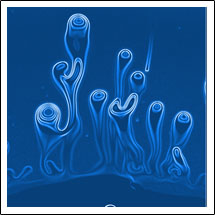
Top: Example of dynamical system governed by coupled set of 4th order nonlinear eqns: Interferometric image of an instability triggered by surfactant transport along the surface of a microscale aqueous film.
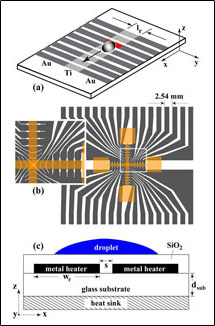
Bottom: Microfluidic chip based on thermocapillary actuation. Embedded arrays of Ti microheaters are used to generate surface temperature maps for shaping, moving, mixing or splitting small liquid structures.
Top: Example of dynamical system governed by coupled set of 4th order nonlinear eqns: Interferometric image of an instability triggered by surfactant transport along the surface of a microscale aqueous film.
Bottom: Microfluidic chip based on thermocapillary actuation. Embedded arrays of Ti microheaters are used to generate surface temperature maps for shaping, moving, mixing or splitting small liquid structures.
Principal Investigator: Biography and Lifelong Research Interests
Prof. Troian directs the Applied Physics Laboratory of Interfacial and Small Scale Transport {LIS2T} at the California Institute of Technology. Her research group specializes in the fundamental science and design of micro- and nanoscale systems involving nonlinear wave phenomena in ultrathin films. Of particular interest are natural or designed phenomena caused by the transport of mass, momentum, heat and light along moving interfaces. Her group relies on theoretical analysis, numerical modeling, experimental work and molecular scale simulations to elucidate system behavior spanning many length scales.
Troian received her B.A. in Physics from Harvard University (1980) and her M.S. (1984) and Ph.D (1987) in Physics from Cornell University. With N. D. Mermin, she developed the first mean field model based on Landau theory for first order phase transitions in quasicrystals. This model revealed how classes of aperiodic structures with icosahedral symmetry can be more energetically favorable than conventional crystalline ordering like BCC or FCC. From 1987-89, Troian was a Postdoctoral Research Associate with the Condensed Matter Physics Group of the Corporate Research Labs at Exxon Research & Engineering Co. There, she used a combination of analytic and experimental work to unveil the source of instability in two classes of thin film flows. The first class exhibits parallel elongations which emanate from the advancing front of many thin film problems driven either by body forces(e.g. gravity or centrifugation) or surface forces (e.g. thermocapillarity). The second class exhibits dendritic patterns which emanate behind the advancing front in thin film problems driven by surface forces (e.g. Marangoni). In 1989, she was awarded a Chateaubriand Research Fellowship to continue this work at the Laboratoire de Physique de la Matière Condensée at the Collège de France in Paris. There she explored how thermocapillary forces can be used to trigger or stabilize leading edge instabilities in microfilms subject to a constant thermal gradient. In a separate study, she examined which energy release mechanisms are dominant during fracture of entangled bulk polymer systems. She returned to the US in 1990 to join the Exxon Research Corporate Research Center in Annandale, NJ as a Staff Physicist. Her interest there in spinodal decomposition phenomena led her to identify how the coupling of Lifshitz-Slyozov dynamics with domain coalescence near a solid boundary can lead to "super-diffusive" growth in binary mixtures. At Exxon, she also investigated hydrodynamic models for oil spill tracking algorithms with emphasis on Marangoni driven coverage during the late stages of an ocean spill.
In 1993, Dr. Troian joined the faculty in the School of Engineering & Applied Science at Princeton University as an Assistant Professor. She was promoted to Associate Professor with tenure in 1999 with affiliation to the Dept. of Physics, Program in Applied and Computational Mathematics, and Dept. of Chemical Eng. She received promotion to Full Professorship in 2002 with additional affiliation to the Dept. of Mechanical and Aerospace Eng. During this period, she established an extensive theoretical and experimental program focused on the physics of surface forces and the modulation of momentum transfer in ultrathin films. At Princeton, she expanded her work beyond continuum-based hydrodynamics and began investigating slip phenomena in confined nanoscale films using non-equilibrium molecular dynamics simulations. These studies on simple and polymeric liquids revealed how molecular layering adjacent to a solid surface in relative motion curtails the transfer of momentum at liquid/solid interfaces. With P. A. Thompson, she uncovered a generalization of the so-called Navier slip condition which suggests the existence of a universal boundary condition for liquid on solid flow, now called the Thompson-Troian slip law. With A. Dussaud, she also uncovered a novel flow instability in ultrathin spreading evaporative films caused by interfacial boundary cooling using a combination of refractive Moiré imaging and fluorescence flow tagging. For this work, they received the American Physical Society François N. Frenkiel Award (1999). In 2000, Troian expanded her interests to include microfluidic systems and with A. A. Darhuber developed the first open architecture microfluidic device based on thermocapillary actuation of free surface films. Using just one tuning parameter, namely temperature, they developed a portable device uniquely capable of transporting, mixing, heating, reacting, separating and optically interrogating small liquid samples for diagnostic applications. They also showed how miniaturized conventional printing techniques like offset and gravure can be used to print photomasks for fabrication of amorphous thin film silicon transistor arrays.
Dr. Troian is recipient of several awards including a National Science Foundation (NSF) Research Initiation Award (1994), an NSF Career Award (1996), an NSF POWRE award (1999), the François N. Frenkiel Award from the American Physical Society (1999), an Engineering Council Award for Excellence in Teaching from Princeton University (1999), a Moore Distinguished Scholar award from the California Institute of Technology (2004 - 05), and a Caltech ASCIT Teaching Award from the Academics and Research Committee (2009). In 2005, Dr. Troian was named a Fellow of the American Physical Society in recognition of her work on interfacial phenomena and instabilities in ultrathin films.
Dr. Troian has served on a number of editorial, executive and advisory boards including the Defense Sciences Research Council which supports the Defense Advanced Research Projects Agency, Annual Reviews of Fluid Mechanics, Physics of Fluids, the Kavli Institute for Theoretical Physics (Santa Barbara, CA), the Microdevices Laboratory of the Jet Propulsion Laboratory (Pasadena, CA), the Max-Planck-Institut für Dynamik und Selbstorganisation (Göttingen, Germany), the Society of Engineering Science, Inc and the Institute for Defense Analysis.
♦ Complete biography can be found here.
♦ Reprints, preprints and other publications can be downloaded here.
Conference and Workshop Presentations
For a listing of recent group presentations at
workshops and conferences, click here
and find section
Conference Presentations.
Press Highlights 1999-2011
Article on in-situ optical microscopy measurements confirming physical mechanism
responsible for nanopillar arrays in molten nanofilms:
- Caltech press release, Experiments Settle Long-Standing Debate about Mysterious Array Formations in Nanofilms, May 17, 2011
- Caltech press release, Caltech Scientists Solve Decade-Long Mystery of Nanopillar Formations: Research Paves Way for New 3-D Lithography Method, October 22, 2009
- Virtual Journal of Nanoscale Science and Technology, Formation of Nanopillar Arrays in Ultrathin Viscous Films: The Critical Role of Thermocapillary Stresses , Vol. 20 (Issue 8), August 24, 2009
- Analytical Chemistry, Diving into Droplets, March 1, 2006 issue, pg. 1401-1404
- Analytical Chemistry: Analytical Currents, Non-intrusive Droplet Analysis, July 2005 issue, pg. 241A
- Virtual Journal of Nanoscale Science and Technology, Influence of boundary slip on the optimal excitations in thermocapillary driven spreading, Vol. 10 (Issue 20), Nov. 15, 2004
- Biochip moves liquids with heat, Technology Research News, April 09, 2003.
- Microfluidics and Jovian Climate, Highlights of DFD Meeting, APS News, Vol. 12, No. 1, January 2003.
- Physics News in 2000 - Biological and Medical Physics (pg 3), Study of thermocapillary flow on micropatterned surfaces cited as one of important physics stories in `00 - APS News, Vol. 20, No. 2, February 2001.
- Microfluidics On the Move: Devices Offer Many Advantages, OE Reports: Technology and Trends for the International Optical Engineering Community, August 2000.
- Microfluidic Technologies on the Rise at DFD Meeting, APS News, Vol. 9, No. 3, March 2000.
- Microfluidic Flows, Physics Today, Physics Update Column, Vol. 53, p. 9 (2000).
- Hot and Cold Chips with Running Fluids, New Scientist, Vol. 164 No. 2215, p. 16 (1999).
- Heat Guides Lab on Chip Flow, Technology Insights - NanoTech Alert, John Wiley & Sons, Dec. 17, 1999.
- TRN News, Process Prints Silicon Circuits, Nov. 5/12, 2003.
- Virtual Journal of Nanoscale Science and Technology, Photoresist-Free Printing of Amorphous Silicon Thin Film Transistors, Vol. 8 (Issue 16), October 2003
- Miniaturization of Offset Printing Down to the Microscale, MRS Spring Meeting 2001, News and Highlights, Tuesday April 17, 2001.
- Coffee Effect Could Benefit Circuit Connections, TRN News, Nov. 2000.
- Continuous Mechanics in Physics Education, by Jerry Gollub, Physics Today, p. 11 (Dec. 2003) [Figure 1].
- A Gallery of Fluid Motion, M. Samimy, K. Breuer, G. Leal and P. Steen, Eds., Cambridge University Press, NY 2004. Our entry in that volume can be viewed by clicking on Streamlets and Branching Dynamics in Surfactant Driven Flows.

Copyright © 2001-2023 Sandra M. Troian. All rights reserved.